Saint-Malo's compulsory radio confiscation
All the Light We Cannot SeeSaint-Malo's compulsory radio confiscation turns the household radio into property the occupying authorities can claim and the resident into a potential saboteur for refusing. At the LeBlanc home, the order means dismantling a collection built up over years and carrying it to a specified address by a strict deadline. It also draws a sharp line between the receivers being surrendered and the transmitter hidden in the attic: a machine Marie-Laure LeBlanc knows about, but does not report.
The order and its threat
Marie-Laure has to ask Daniel LeBlanc three times before he reads the notice aloud. It directs residents to relinquish every radio receiver in their possession and deliver the sets to 27 rue de Chartres before noon the next day. Anyone who fails to comply will be arrested as a saboteur. The notice presents surrender as a civic requirement, but its threatened punishment makes clear that compliance is enforced by the occupying power, not freely chosen.
For Marie-Laure, the deadline immediately acquires a domestic scale: half the house, she realizes, is occupied by receivers and their components. The order does not simply remove a single appliance. It reaches into a home where radio equipment has accumulated in different forms, making the family's ordinary possessions subject to inspection and removal. Its formal language gives that coercion an administrative face: residents are told where to go and by when, while the consequences of refusal are made explicit.
Packing the household collection
Madame Manec knocks at Henri LeBlanc's room and gets no answer. That afternoon, she and Daniel unplug the sets and lower them into crates in Etienne LeBlanc's study. Marie-Laure sits on the davenport listening as each radio goes silent in turn: an old Radiola Five, a G.M.R. Titan, a G.M.R. Orphée, and a Delco thirty-two-volt farm radio that Etienne LeBlanc had shipped from the United States in 1922. Their differing names and histories make the loss tangible; these are not interchangeable objects to the people who have lived among them.
Daniel wraps the largest set in cardboard and uses an old wheeled dolly to take it downstairs. The next morning, while Etienne LeBlanc remains shut inside his brother's room, Daniel begins the delivery at ten. He makes one trip, then another, then a third. When he returns for the last radio, Etienne LeBlanc still has not appeared. Marie-Laure holds Madame Manec's hand as she hears the gate close and the cart's axle bounce away down rue Vauborel. The sound of the delivery gives way to the silence left behind; the house has been emptied of its receivers, but the order has not resolved what is happening within it.
The transmitter beyond the inventory
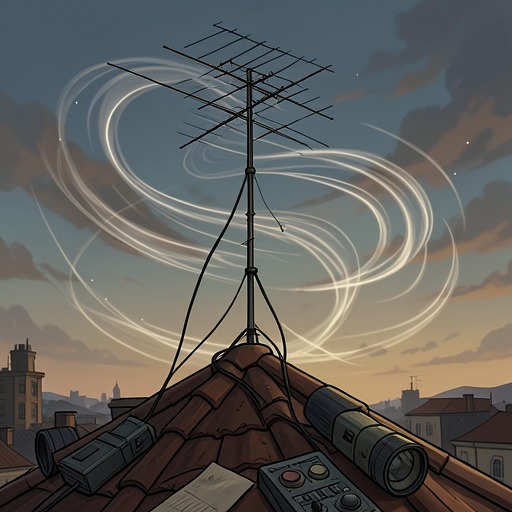
The removal also exposes the limits of the order as Marie-Laure understands it. She thinks of the machine in the attic, with its cables and switches, and wonders whether it counts as a radio receiver, whether she should mention it, and whether Daniel LeBlanc and Madame Manec even know it is there. The transmitter was built to send, not simply receive. She does not disclose it in this scene, and the family's delivery therefore does not include it. The distinction is consequential: the authorities' demand reaches the conspicuous household sets, while a different kind of radio apparatus remains unlisted.
The attic machine belongs to a wider story in which radio depends on physical materials and practical skill. As a child, Werner Pfennig finds a crude receiver made from a wire-wrapped cylinder, pinewood discs, and dangling electrical leads. Later, trapped beneath rubble with Frank Volkheimer, he makes another receiver by coiling wire around a pipe and joining the circuit to a diode, battery, and earphone. These scenes do not alter the confiscation's immediate course, but they clarify what the surrendered sets represent: radio is equipment that can be dismantled, improvised, or repurposed, not merely a fixed object whose removal ends communication.
Coercion and the persistence of radio
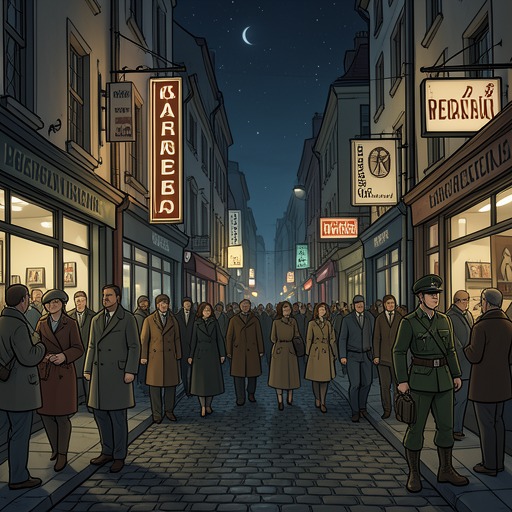
The order's warning that defiance will be treated as sabotage makes a household decision legible to the authorities as a security offense. Its force is echoed later in the occupied city by other measures controlling civilian movement: Marie-Laure hears that the gates have been locked and that men aged sixteen to sixty are to be detained and marched to Fort National. The measures are distinct, but together they show a regime that reaches into homes and streets through instructions backed by the threat of confinement.
Radio likewise persists in forms beyond the family collection. A military radio truck carries listening decks, an antenna, headsets, maps, and transceivers designed by Werner Pfennig with Dr. Hauptmann. In the besieged city, Marie-Laure raises the attic transmitter's antenna and hopes someone might hear her. Set beside the confiscation, these later uses sharpen the event's significance: removing receivers from residents does not extinguish radio's capacity to connect people. The collection is surrendered, the household falls quiet, and the transmitter remains a possibility the notice has not managed to make disappear.